Glenn O. Coleman
About the artist:
Glenn O. Coleman (American, 1887–1932) was a distinguished painter, printmaker, and illustrator renowned for his vivid portrayals of urban life in early 20th-century New York. Born in Springfield, Ohio, he moved to Indianapolis, Indiana with his family and completed his public schooling there.
From an early age, Glenn displayed an interest in drawing. He would spend hours sketching scenes from his neighborhood, capturing the architecture and the people he observed in his daily life. His father often took him on walks around Indianapolis, pointing out the intricate details of Victorian homes and the patterns in wrought iron fences. These excursions instilled in Glenn an appreciation for structure and design, elements that would later become central to his artistic style.
After graduation from high school, Coleman briefly attended a local college, where he studied art history and literature. However, after the sudden passing of his father, economic pressures at home forced him to leave school and seek employment. He found work as a clerk in a downtown department store, but he continued to draw in his spare time, filling sketchbooks with observations of urban life. He also took night classes at the Indianapolis Art Institute, where he was exposed to new techniques and artistic movements. The Institute’s faculty encouraged experimentation, and Glenn began to explore modernist approaches to composition and color.
While still a young man, Coleman eventually moved to New York City where he quickly became immersed in the city’s dynamic art scene.
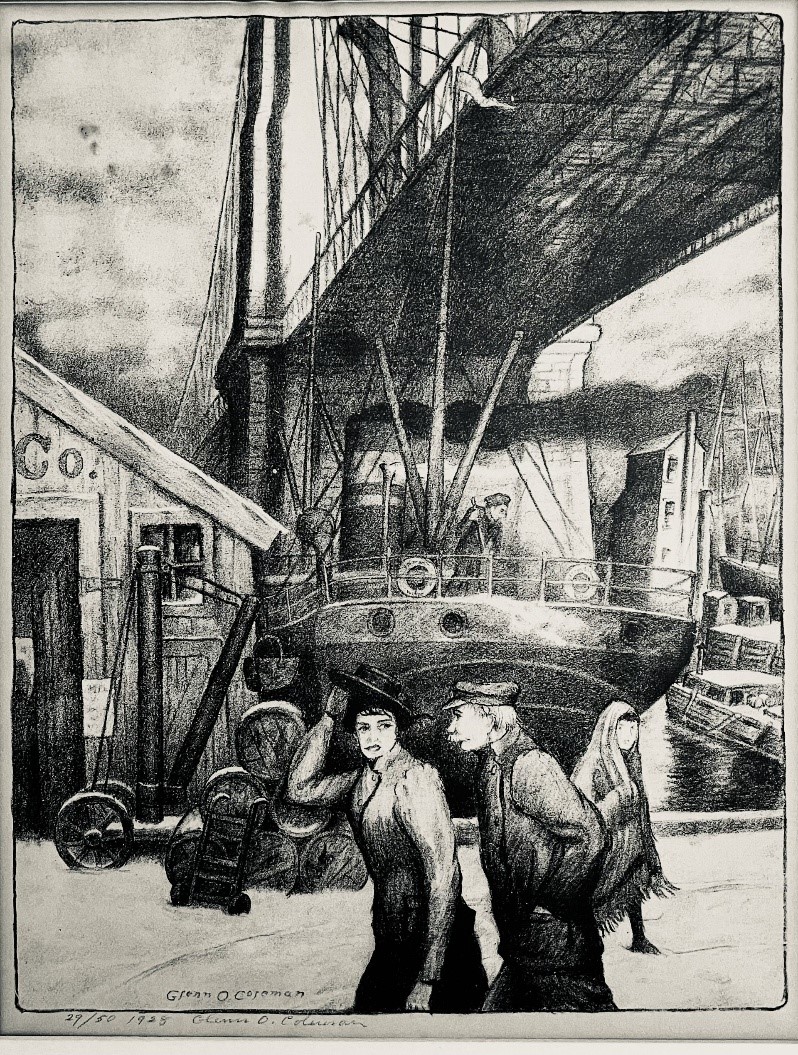
Glenn O. Coleman (American 1887 – 1932)
Price - $2,200
He studied at the Chase School, later known as Parsons School of Design, and his education was rooted in both traditional and modernist approaches. Coleman’s work often captured the energy and rhythms of New York, with bustling streets, towering architecture, and everyday scenes rendered in bold lines and striking compositions.
As a member of the so called “Ashcan” School, Coleman was aligned with artists such as Robert Henri, George Bellows and others who sought to depict the realities of urban existence rather than idealized subjects. His linocuts and lithographs, in particular, reflect a keen eye for detail and a deep appreciation for the interplay of light and shadow. Coleman’s art was exhibited at major venues such as the Whitney Studio Club and the Society of Independent Artists, earning him recognition among critics and collectors as well as numerous awards. He also contributed illustrations to prominent magazines, further cementing his reputation as a versatile artist.
Though his life was tragically cut short at the age of 45, his legacy endures through works that continue to resonate for their authenticity and artistic innovation. Coleman’s paintings and prints are held in numerous major museum collections across the United States and Europe as well as in many important private and corporate collections.